
How to Get a Flat Tummy, Lose Weight & Build a Stronger, Healthier Life: The SHVTAS 360° Guide for Women

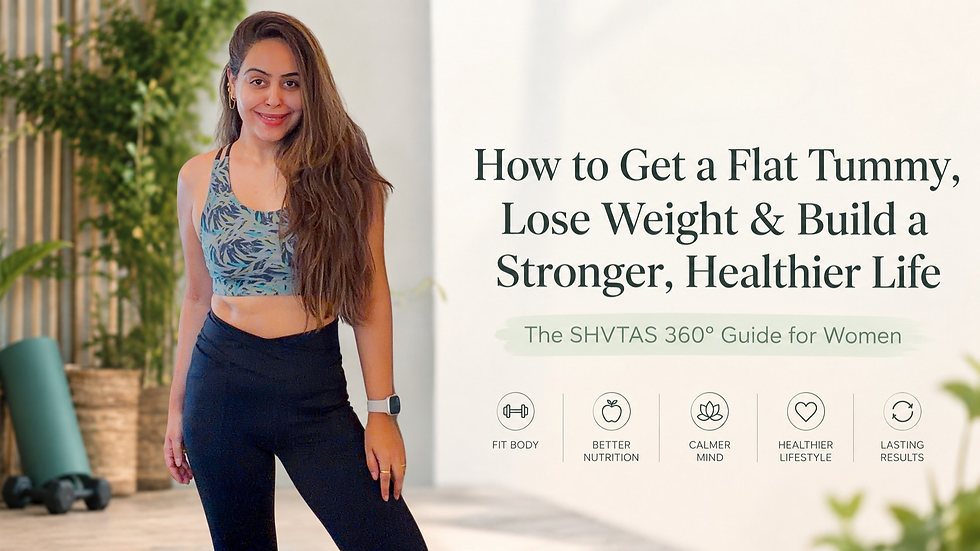
A practical, science-informed approach to fat loss, strength, nutrition, movement, mindset and sustainable wellness—especially for Indian women.
A flat tummy is often presented as a destination.
Six-pack abs. A smaller waist. A lower number on the weighing scale.
But what if the real goal isn’t simply to have a flat stomach?
What if the goal is to have a stronger body, healthier metabolism, better energy, calmer mind, better sleep, healthier food habits, confidence in your body—and a lifestyle you can actually sustain?
At SHVTAS, I believe wellness isn’t about constantly trying to become smaller.
It is about becoming stronger, healthier and more intentional about the way you live.
And the beautiful part?
You don’t need to spend your entire day exercising or live on salads to get there.
For most women, one intentional hour a day, combined with sensible nutrition and consistent everyday habits, can create a remarkable transformation over time.
This is the SHVTAS approach to creating a toned body, healthier weight, stronger mind and better life.
First: Let’s Talk About the “Flat Tummy”
Let’s clear up one of the biggest myths around fitness.
You cannot selectively burn belly fat.
Doing hundreds of crunches does not specifically tell your body to burn fat from your stomach.
Your body decides where it stores and releases fat based on multiple factors, including genetics, hormones, age, energy balance, activity levels and overall body composition.
So instead of asking:
“How do I lose belly fat?”
Ask:
“How do I reduce overall body fat while building muscle and improving my body composition?”
That is the more useful question.
As your overall body fat decreases and your muscle mass and posture improve, your waist can become smaller and your body can look significantly more toned.
And sometimes the weighing scale doesn’t move dramatically because you’re simultaneously losing fat and building or maintaining muscle.
That’s why body composition matters more than the number on the scale alone.

THE SHVTAS 360° FORMULA
Think of your health as a system rather than a single goal.
BODY
Nutrition
Strength training
Cardio
Steps
Mobility
Hydration
METABOLISM
Adequate protein
Sufficient calories
Muscle mass
Daily movement
Sleep
Recovery
MIND
Stress management
Meditation
Mental resilience
Emotional eating awareness
Positive self-talk
LIFESTYLE
Family
Social life
Work
Travel
Festivals
Indulgences
Rest
CONSISTENCY
Not perfection.
Because a healthy lifestyle that works only when life is perfect isn’t actually a healthy lifestyle.

1. START WITH YOUR REAL GOAL
Don’t simply write:
“I want to lose 10 kg.”
Make your goal multidimensional.
For example:
My 90-day goal:
Lose excess body fat
Reduce waist circumference
Improve strength
Increase daily steps
Eat enough protein
Sleep 7–9 hours
Drink adequate water
Reduce mindless snacking
Improve energy
Build consistency
Feel comfortable in my clothes
Develop a lifestyle I can maintain
This shifts your focus from weight loss to health transformation.
2. UNDERSTAND CALORIE DEFICIT
Fat loss ultimately requires an energy deficit over time.
In simple terms:
Energy consumed < Energy used
But this does NOT mean:
Eat as little as possible.
Extreme restriction can make it harder to maintain your diet, compromise training and recovery, and increase hunger and food preoccupation.
Your calorie needs depend on factors such as:
Age
Sex
Height
Weight
Muscle mass
Daily movement
Exercise
Occupation
Sleep
Individual physiology
Goals
There is no universal “1200-calorie diet” for every woman.
A 28-year-old woman who trains five times a week and a 42-year-old woman with a sedentary lifestyle do not necessarily have the same energy requirements.
3. HOW TO ESTIMATE YOUR CALORIE NEEDS
A useful starting point is estimating your Basal Metabolic Rate (BMR)—the energy your body requires at rest.
One commonly used equation is the Mifflin-St Jeor equation.
For women:
BMR ≈ 10 × weight (kg) + 6.25 × height (cm) − 5 × age − 161
Your BMR is not your daily calorie requirement.
You also need energy for:
Walking
Working
Digestion
Exercise
Household activities
General movement
This is why we estimate Total Daily Energy Expenditure (TDEE).
A calorie deficit can then be created from your estimated maintenance intake.
But remember:
These calculations are estimates—not laboratory measurements.
Your actual weight trend, hunger, energy, performance, recovery and measurements provide useful real-world feedback.
4. DON’T CHASE THE BIGGEST POSSIBLE DEFICIT
A moderate, sustainable deficit is generally more practical than aggressive restriction.
Think:
“What is the smallest deficit that produces meaningful progress while allowing me to live my life?”
This is especially important for women who:
Work
Have children
Travel
Socialise
Exercise
Manage households
Experience menstrual-cycle changes
Have demanding schedules
You don’t need to be hungry all day to lose fat.
5. PROTEIN IS YOUR BEST FRIEND
If you want a toned body, don’t focus only on eating less.
Focus on maintaining or building muscle.
Protein supports:
Muscle repair
Muscle growth
Satiety
Recovery
Preservation of lean mass during fat loss
A practical target for many active women is approximately:
1.2–1.6 g protein/kg body weight/day
Individual requirements can vary.
Indian protein sources
Vegetarian
Paneer
Tofu
Greek yogurt/hung curd
Milk
Dal
Rajma
Chole
Soy
Soya chunks
Besan
Sattu
Non-vegetarian
Eggs
Chicken
Fish
Lean meat
Prawns
Greek yogurt alongside meals
The SHVTAS rule:
Don’t ask:
“How do I remove carbs?”
Ask:
“Where is my protein?”
6. DON’T BE AFRAID OF CARBOHYDRATES
Rice is not the enemy.
Roti is not the enemy.
Potatoes are not the enemy.
Fruit is not the enemy.
Indian food can absolutely be part of a fat-loss diet.
Your goal is to manage:
quantity + quality + overall calories + protein + fibre + consistency.
Instead of eliminating rice:
Measure your portion.
Instead of eliminating roti:
Pair it with protein and vegetables.
Instead of avoiding fruit:
Eat whole fruit and account for your overall intake.
You don’t need to abandon Indian food to become healthier.
You need to learn how to structure Indian food intelligently.
7. BUILD YOUR INDIAN PLATE
A simple framework:
½ PLATE Vegetables + salad
¼ PLATE Protein
¼ PLATE Carbohydrates
Add an appropriate amount of healthy fats.
For example:
Lunch
Rice + dal + grilled chicken/paneer + sabzi + salad + curd
or
2 rotis + paneer/tofu/chicken + sabzi + salad + curd
The exact portions depend on your calorie and protein needs.

8. FIBRE MATTERS
Fibre helps support:
Satiety
Digestive health
Regular bowel movements
Blood glucose management
Overall dietary quality
Include:
Vegetables
Fruits
Legumes
Whole grains
Seeds
Nuts
Salads
And increase fibre gradually if your current intake is low.
9. WATER: THE MOST UNDERRATED WELLNESS HABIT
Hydration isn’t a magical fat burner.
But adequate hydration supports normal physiological function and can make healthy eating easier.
Many women mistake thirst, fatigue or habit for hunger.
Keep water accessible.
Create simple cues:
Wake up → water
Before leaving home → water
At your desk → water
Before/after workout → water
With meals → water according to comfort
Your individual needs depend on body size, activity, climate and other factors.
In India’s heat, hydration becomes particularly important.
10. THE ONE-HOUR SHVTAS RULE
You don’t need three hours in the gym.
Think of your day as a series of small health investments.
YOUR ONE HOUR
20–30 minutes: Strength training
15–20 minutes: Walking/cardio
5–10 minutes: Mobility/stretching/breathwork
That’s it.
And then let the rest of your day support the work you’ve done.
Walk more.
Take stairs.
Stand up regularly.
Move around the house.
Play with your children.
Walk while taking a phone call.
Your workout is important.
But your entire day’s movement matters too.

11. STRENGTH TRAINING IS NON-NEGOTIABLE FOR A TONED BODY
If your goal is:
“I want to lose weight but also look toned.”
Strength training deserves a place in your routine.
Resistance training can help you:
Build muscle
Preserve lean mass during weight loss
Improve strength
Support healthy body composition
Improve functional fitness
Make everyday movement easier
You don’t need to become a bodybuilder.
You simply need to progressively challenge your muscles.
Start with:
Squats
Lunges
Rows
Push movements
Hip hinges
Glute bridges
Shoulder presses
Core exercises
As you become stronger, gradually increase resistance, repetitions, sets or difficulty.
12. CARDIO STILL HAS A PLACE
Walking, running, cycling, swimming, dancing, Zumba or other aerobic activities can contribute to cardiovascular fitness and energy expenditure.
You don’t have to choose:
Strength OR cardio.
A healthy programme can include both.
For women who love dancing:
Zumba absolutely counts as movement.
For women who hate running:
You don’t have to run.
Walking consistently is a fantastic starting point.
13. YOUR 8,000–10,000 STEPS ARE NOT A MAGIC NUMBER
You don’t suddenly start burning fat at exactly 10,000 steps.
Think of step counts as a movement target, not a magical fat-loss switch.
If you currently average 3,000 steps:
Try 5,000.
Then 7,000.
Then 8,000+.
The best number is one you can consistently maintain.
14. TRAIN YOUR CORE—but UNDERSTAND WHAT IT DOES
Core training can improve:
Trunk strength
Stability
Posture
Movement control
Exercises can include:
Planks
Dead bugs
Bird dogs
Side planks
Pallof presses
Controlled leg raises
But remember:
Core exercises strengthen your core. They don’t selectively melt abdominal fat.
Your flatter-looking stomach comes from the combination of:
lower overall body fat + muscle development + posture + reduced bloating + genetics + individual anatomy.
15. SLEEP IS PART OF YOUR FAT-LOSS PLAN
You cannot out-train chronic sleep deprivation.
Poor sleep can affect:
Hunger
Food cravings
Recovery
Mood
Exercise performance
Decision-making
Aim for approximately 7–9 hours of sleep when possible.
Create a sleep ritual:
Consistent bedtime
Dim lights at night
Reduce unnecessary screen stimulation
Finish heavy meals well before bed where practical
Keep your bedroom comfortable
Give yourself time to wind down
16. STRESS MANAGEMENT IS NOT OPTIONAL
A constantly stressed woman cannot simply “discipline” herself into feeling well.
Your nervous system matters.
Try:
5–10 MINUTES DAILY
Meditation.
Deep breathing.
Prayer.
Journaling.
A slow walk.
Time in nature.
Digital detox.
Yoga.
Silence.
Whatever helps you transition from:
DOING → BEING.
You don’t need a 60-minute meditation session.
Five mindful minutes every day can be a powerful starting point.
17. STOP USING FOOD AS A MORAL SCORECARD
This is one of the biggest mindset shifts.
Pizza isn’t “bad.”
Cake isn’t “bad.”
Ice cream isn’t “bad.”
A festival meal isn’t “cheating.”
Food is food.
The issue is frequency, quantity, context and overall dietary pattern.
You can eat nutritious food most of the time and still enjoy celebrations.
18. HAVE THE ICE CREAM
Yes.
Have the ice cream.
Go out with your children.
Have the family dinner.
Eat the birthday cake.
Enjoy Diwali.
Enjoy Christmas.
Travel.
Try local food.
Have your favourite dessert.
The goal isn’t to become the woman who never eats anything indulgent.
The goal is to become the woman who can enjoy indulgence without turning one meal into a week-long spiral.
19. THE MOST IMPORTANT RULE AFTER AN INDULGENCE
Don’t punish yourself.
Don’t:
Starve the next day
Do three hours of cardio
Skip every carbohydrate
Feel guilty
Decide you’ve “ruined everything”
Instead:
Next meal → back to normal.
That’s the skill.
Not perfection.
Recovery.
A healthy lifestyle is not:
Monday perfect
Tuesday perfect
Wednesday perfect
Thursday perfect…
It is:
Good day → indulgence → reset → good day → travel → reset → celebration → reset.
20. LEARN THE 80/20 MINDSET
A practical lifestyle can look like:
80–90% nutrient-dense, minimally processed foods
and
10–20% flexibility and enjoyment
The exact percentage doesn’t need to be mathematical.
The principle is:
Most of your choices support your health. Some choices simply support your happiness.
Both matter.
21. PLAN YOUR MEALS BEFORE HUNGER ARRIVES
One of the easiest ways to lose control around food is to wait until you’re starving before deciding what to eat.
Instead, plan your basic day.
BREAKFAST
Protein + fibre + healthy fat
Examples:
Eggs + vegetables + fruit
Greek yogurt + fruit + seeds
Besan chilla + curd
Paneer/tofu bhurji + roti
LUNCH
Protein + vegetables + carbohydrates
Rice + dal + chicken/paneer + sabzi + salad
or
Roti + protein + sabzi + curd
SNACK
Protein/fibre-based option
Greek yogurt
Fruit + nuts
Protein shake
Roasted chana
Sattu
Eggs
DINNER
Protein + vegetables + appropriate carbohydrates
Chicken/fish + vegetables + roti
Paneer/tofu + vegetables
Dal + sabzi + roti
22. DON’T DRINK YOUR CALORIES WITHOUT REALISING IT
Coffee, smoothies, juices, sweetened beverages and speciality drinks can quietly add calories.
This doesn’t mean you can never drink them.
It means:
Know what you’re consuming.
If you’re trying to create a calorie deficit, liquid calories can be easy to overlook.
23. TRACKING CAN BE YOUR EDUCATION TOOL
You don’t have to track calories forever.
But tracking for a period can teach you:
Portion sizes
Protein intake
Hidden calories
Oil consumption
Snack calories
Restaurant portions
Beverage calories
Your actual calorie intake
For Indian women, cooking oil, ghee, nuts, sauces, sweets and weekend meals can make a significant difference because they’re energy-dense.
You don’t necessarily need to eliminate them.
You need to understand them.
24. MEASURE MORE THAN YOUR WEIGHT
The scale is only one data point.
Track:
BODY
Weight
Waist
Hip
Thigh
Arm
FITNESS
Strength
Steps
Workout consistency
Cardio endurance
WELLNESS
Sleep
Energy
Mood
Digestion
Menstrual-cycle patterns where relevant
VISUAL
Take progress photographs under similar lighting and clothing.
Sometimes your body changes significantly before the scale reflects the transformation you see in the mirror.
25. WOMEN OVER 35 NEED TO THINK BEYOND WEIGHT
As women move through their 30s and 40s, priorities often shift.
The goal should increasingly be:
muscle + metabolic health + bone health + cardiovascular health + mobility + recovery + mental wellbeing.
Don’t build your entire identity around being thin.
Build a body that can carry you strongly through the next several decades of your life.
26. DON’T BLAME EVERYTHING ON YOUR METABOLISM
“My metabolism is slow” is often used as an explanation for weight gain.
But metabolism isn’t a fixed number.
Your energy expenditure is influenced by:
Body size
Muscle mass
Physical activity
Non-exercise movement
Food intake
Adaptation to weight loss
Sleep
Age
Individual physiology
The solution isn’t a miracle metabolism drink.
It is:
Build muscle. Move more. Eat appropriately. Sleep. Recover. Repeat.
27. AND NO, DETOX WATER DOESN’T DETOX YOUR BODY
Lemon water.
Cucumber water.
Mint water.
Ginger water.
These can be refreshing ways to increase fluid intake.
But your liver, kidneys, lungs and gastrointestinal system already perform the body’s detoxification processes.
Use infused water because you enjoy it—not because you believe it is melting belly fat.
28. SUPPLEMENTS COME AFTER THE BASICS
Supplements can have a role when there is a genuine nutritional need or an evidence-based reason to use them.
But they should not replace:
food + movement + sleep + strength training + stress management.
Before taking supplements for specific deficiencies or medical concerns, speak with an appropriately qualified healthcare professional.
29. YOUR PERIOD IS PART OF YOUR WELLNESS
Women aren’t machines.
Energy, appetite, mood, training performance and water retention can fluctuate across the menstrual cycle.
You may notice:
Temporary weight gain
Increased appetite
Bloating
Lower energy
Changes in training performance
Don’t interpret every fluctuation as fat gain.
Your body is dynamic.
If you have very painful periods, abnormal bleeding, significant fatigue or other concerning symptoms, consult a qualified healthcare professional rather than trying to solve everything through diet and exercise.
30. YOUR PERFECT DAY DOESN’T NEED TO BE PERFECT
Here’s what a realistic SHVTAS wellness day can look like:
MORNING
Wake up.
Hydrate.
Get some daylight.
A few minutes of mindfulness.
Protein-rich breakfast.
Start your workday.
DAY
Move regularly.
Eat a balanced lunch.
Drink water.
Walk after meals where practical.
Don’t wait until you’re starving to eat.
EVENING
Strength training / Zumba / yoga / brisk walk.
Protein-rich dinner.
Family time.
Reduce unnecessary screen stimulation.
NIGHT
Reflect.
Breathe.
Prepare for tomorrow.
Sleep.
This isn’t glamorous.
It’s boring consistency.
And boring consistency is incredibly powerful.
31. CREATE YOUR ONE-HOUR NON-NEGOTIABLE
If your schedule is chaotic, stop waiting for the “perfect time.”
Create one protected hour.
For example:
OPTION A — MORNING
30 min strength15 min walk10 min mobility5 min meditation
OPTION B — EVENING
40 min strength/cardio10 min walk10 min breathwork
OPTION C — SPLIT IT
20 min morning walk
20 min strength later
20 min evening walk/yoga
Your hour doesn’t have to happen continuously.
It just needs to happen.
32. USE THE “MINIMUM DAY” RULE
Some days you will be exhausted.
Some days your child will need you.
Some days work will explode.
Some days you will travel.
Some days you will get your period.
Some days you simply won’t feel like working out.
Don’t quit.
Have a minimum version.
Instead of:
“Workout or nothing.”
Think:
“10-minute walk.”
“10 squats + 10 push-ups + 10 rows.”
“Five minutes of stretching.”
“Go outside and walk.”
The objective is to maintain the identity:
I am someone who takes care of my body.
33. YOUR FAMILY SHOULD NOT HAVE TO LIVE A “DIET LIFE”
One of the most beautiful things you can do as a mother is demonstrate what a healthy relationship with food and movement looks like.
Let your children see you:
Enjoy food
Cook at home
Eat vegetables
Eat protein
Exercise
Rest
Laugh
Celebrate
Have dessert
Return to your routine
Don’t teach:
“Cake makes you fat.”
Teach:
“Cake is something we enjoy sometimes, and our everyday food gives our body what it needs.”
That is a healthier relationship with food.
34. YOUR HOME ENVIRONMENT MATTERS
Make the healthy choice easier.
Keep:
Fruits visible
Protein options ready
Washed vegetables accessible
Greek yogurt available
Eggs stocked
Healthy snacks portioned
Water bottle nearby
And don’t keep every tempting food permanently within arm’s reach if you know you tend to mindlessly eat it.
Environment often beats willpower.
35. BUILD A WEEKLY SYSTEM
Instead of planning your entire life every morning, create a weekly rhythm.
SUNDAY RESET
Plan:
Workouts: 3–4 sessions
Walking: daily movement target
Protein: grocery planning
Vegetables: prep
Breakfast: decide options
Lunch: plan basic meals
Dinner: plan basic meals
Family meal: schedule it
Indulgence: allow it intentionally
Sleep: protect bedtime
This turns health into a system instead of a daily negotiation.
36. THE SHVTAS WEEKLY CHECK-IN
Every SUNDAY, ask yourself:
BODY
Did I move enough?
STRENGTH
Did I train my muscles?
FOOD
Did I eat enough protein and vegetables?
HYDRATION
Did I drink enough water?
SLEEP
Did I protect my sleep?
MIND
Did I give myself quiet time?
LIFE
Did I enjoy my family?
JOY
Did I do something simply because I loved it?
CONSISTENCY
Where did I do well?
RESET
What is one thing I will improve next week?
37. DON’T LET ONE BAD DAY BECOME A BAD WEEK
This may be the most important rule in sustainable weight management.
A heavy dinner is one meal.
A birthday is one day.
A holiday is a few days.
A vacation is temporary.
Your health is built over months and years.
The question isn’t:
“Did I mess up?”
The question is:
“What does my next healthy choice look like?”
38. THE REAL SECRET TO A TONED BODY
There isn’t one.
It is the accumulation of simple things:
Adequate protein
Strength training
Daily movement
A sustainable calorie deficit when fat loss is the goal
Enough fibre and nutritious food
Hydration
Sleep
Stress management
Consistency
Enjoyment
Time
That is the formula.
39. THE SHVTAS 10-POINT DAILY CHECKLIST
Every day, aim to tick as many as you realistically can:
☐ Protein at meals
☐ Vegetables/fruit
☐ Adequate hydration
☐ Daily movement
☐ Strength/cardio as scheduled
☐ Mostly nourishing food
☐ Mindful eating
☐ Time with family
☐ 5–10 minutes of mental reset
☐ Good sleep routine
You don’t need 10/10 every day.
Aim for consistency, not perfection.
40. THE ONE-HOUR INVESTMENT
Imagine giving yourself just one hour a day.
Not for vanity.
For your future self.
Thirty minutes to build muscle.
Fifteen minutes to move your heart and body.
Ten minutes to stretch, breathe or meditate.
Five minutes to plan.
One hour.
And then you go live your life.
You work.
You raise your children.
You meet friends.
You travel.
You celebrate.
You eat.
You laugh.
You have dessert.
You live.
Because fitness should not become another full-time job.
MY PHILOSOPHY
I don’t believe women need another diet.
I believe women need a system for living well.
A system that allows you to be strong without becoming obsessive.
Healthy without becoming restrictive.
Fit without sacrificing your family life.
Mindful without becoming rigid.
Disciplined without losing joy.
And ambitious without abandoning yourself.
Your body doesn’t need punishment.
It needs movement.
Your mind doesn’t need constant pressure.
It needs space.
Your diet doesn’t need perfection.
It needs balance.
Your lifestyle doesn’t need to be extreme.
It needs consistency.
And your transformation doesn’t need to happen overnight.
It needs you to show up—again and again.
So start with one hour.
One meal.
One walk.
One workout.
One glass of water.
One better choice.
One deep breath.
And then do it again tomorrow.
Because the goal isn’t simply to get a flat tummy.
The goal is to build a body you are proud to live in, a mind you feel peaceful inside, and a lifestyle you don’t need a vacation from.
This is wellness.
This is the my way , this is SHVTAS way.

Important Note
This article is for general educational purposes and is not a substitute for personalised medical, nutritional or fitness advice. Calorie requirements, exercise tolerance, nutritional needs and weight-management strategies vary between individuals. Women who are pregnant, breastfeeding, have a medical condition, take medication, have a history of disordered eating, or experience significant menstrual or metabolic symptoms should seek personalised guidance from an appropriately qualified healthcare professional.





Comments